
Dental Billing and Denials: A CDT-Specific Evidence and Payment Workflow
Build a dental billing workflow for benefits, documentation, current CDT review, electronic submission, payer denials, coordination, and payment reconciliation.
Direct answer
Dental billing workflow: what operators need to know
Build a dental billing workflow for benefits, documentation, current CDT review, electronic submission, payer denials, coordination, and payment reconciliation. Keep dental and medical code sets and transaction pathways distinct. Verify benefits and limitations for the actual plan and service. Do not alter service dates, procedures, or clinical facts to obtain payment.
Five recent denials · Drafts back in 7 days · A de-identified worksheet, not the charts
See the workflow: Medical billing workflows.
On this page: Direct answer
Dental billing requires dental-specific coding, benefit review, documentation, transaction, and payment controls. Use current licensed CDT resources and the applicable plan's requirements. A medical billing checklist can provide useful ownership principles, but its codes and assumptions should not be copied into dental transactions.
Start with the service actually provided and the evidence that supports it. The treating professional retains clinical authority; administrative work organizes accurate information, resolves the payer's actual question, and tracks the resulting financial events.
Key takeaways
The short version
- Keep dental and medical code sets and transaction pathways distinct.
- Verify benefits and limitations for the actual plan and service.
- Do not alter service dates, procedures, or clinical facts to obtain payment.
- A denial response and a deposit reconciliation are separate pieces of work.
Verify the benefit without promising the final payment
Record the plan, service, date, network arrangement, relevant benefit limitations, and source. Ask the questions the actual service requires rather than treating general eligibility as complete financial clearance. Keep estimates, unresolved questions, and confirmed decisions clearly labeled.
Where pre-treatment review or another plan process applies, preserve what the response establishes and what it does not. The patient-facing explanation should not convert a limited response into a guarantee of payment.
Review the supported service using current dental resources
Qualified staff use the current licensed CDT material and applicable payer instructions. Record the procedure actually performed and supported by the clinical record. Avoid choosing a different procedure solely to bypass a benefit limitation or obtain a more favorable reimbursement.
Do not substitute a medical procedure code because a dental service was denied. When medical coverage may be relevant, qualified reviewers determine the applicable coordination, documentation, coding, and transaction requirements for that actual situation.
Evaluate the dental clearinghouse path
Confirm supported dental transactions, payer enrollment, attachments where applicable, acknowledgment visibility, remittance delivery, and correction procedures. Medical transaction connectivity does not independently establish dental transaction readiness for every payer.
Ask the vendor to demonstrate a fictional routine submission and a failed version. Inspect the original response, affected record, correction route, and receiving acknowledgment. Confirm export and support ownership before a cutover.
Respond to the stated denial instead of sending a generic letter
Preserve the original reason and determine whether the next step is correction, evidence, clarification, reconsideration, appeal, or another permitted route. For missing documentation, create an item-by-item index and obtain authorized clinical and disclosure review.
There is no reliable universal list of the procedures most denied for every practice. Analyze your own payer, service, and reason cohorts with stable definitions. A frequency limit, missing evidence, enrollment issue, and unsupported coding decision require different responses.

Make billing integrity a reviewable process
Train staff to raise discrepancies involving services not performed, inaccurate dates, unsupported coding, duplicate transactions, inappropriate balance transfers, or altered records. Preserve the evidence and use the organization's approved review and correction route. Do not label every mistake as intentional wrongdoing without investigation.
A useful control asks whether the service, code, date, entity, supporting record, and transaction history agree. Resolve the discrepancy with qualified owners and retain the correction history. A software checkmark alone does not establish legal compliance.
Reconcile the decision, posting, and deposit
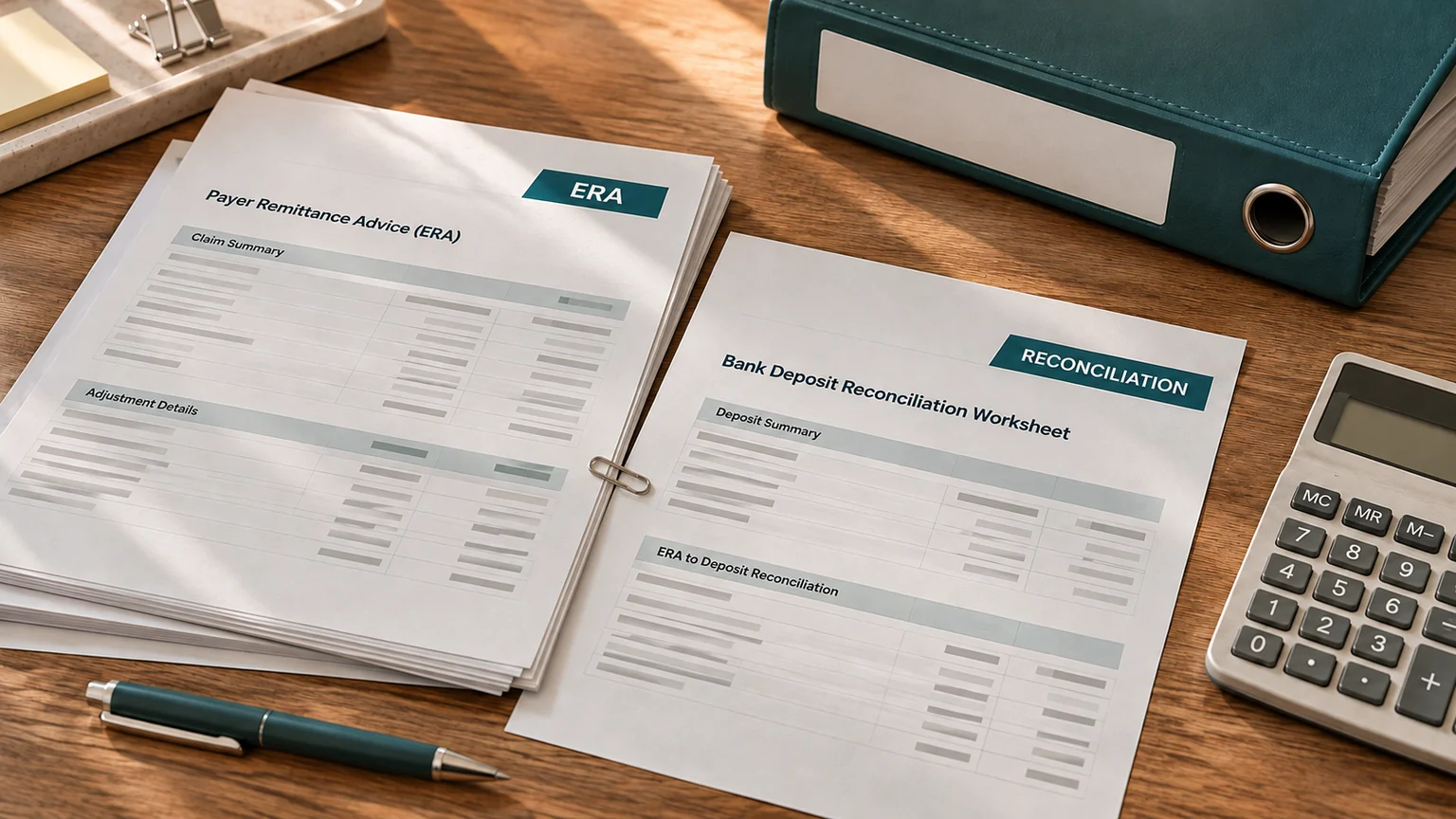
Match the remittance or other payer explanation with ledger entries and bank evidence. Review adjustments, offsets, reversals, and responsibility allocation against the contract and applicable requirements before patient billing. An automated posting success can still leave an unresolved financial difference.
Use an owned exception queue for unmatched deposits, missing remittances, unposted decisions, and unsupported adjustments. Keep the reviewer, supporting basis, and next check visible until the difference is explained or an authorized resolution is recorded.
Common questions
Answers before you build.
Can a medical clearinghouse automatically handle dental billing?
Verify dental transaction support, payer connectivity, enrollment, attachments where applicable, remittance routing, and correction workflows. Medical connectivity alone is not sufficient evidence.
Should a denied dental procedure be replaced with a medical code?
No automatic substitution is appropriate. Qualified reviewers determine whether medical coverage is relevant and which documentation, coordination, coding, and transaction requirements actually apply.
What should a dental denial response contain?
Address the payer's actual reason using accurate supported information, the applicable response route and timing, an evidence index when needed, and authorized clinical and disclosure review.
Practical closeout
Use this operator checklist.
- Keep dental and medical code sets and transaction pathways distinct.
- Verify benefits and limitations for the actual plan and service.
- Do not alter service dates, procedures, or clinical facts to obtain payment.
- A denial response and a deposit reconciliation are separate pieces of work.
Continue through the cluster
Verified customer case studies are added only with customer permission and supporting evidence; none is implied by these operational examples.
Sources & methodology
Trace the operational claims.
Marsa Health Editorial reviewed the primary and research sources below on November 5, 2026. We translate them into workflow controls, distinguish proposals from final rules, and flag where plan, program, state, contract, or clinical requirements vary.
- 01Dental procedure code questions American Dental AssociationCDT and medical code sets are distinct; use licensed current resources and applicable plan instructions.Accessed or rechecked November 5, 2026
- 02ADA dental claim form American Dental AssociationOfficial claim-form resources; this guide does not reproduce the copyrighted form or code descriptors.Accessed or rechecked November 5, 2026
- 03Health care payment and remittance advice CMSExplains remittance advice and payment information. A remittance and a bank deposit are different evidence.Accessed or rechecked November 5, 2026
- 04Minimum necessary requirement HHSPrivacy guidance with defined scope and exceptions; organizations establish approved information handling.Accessed or rechecked November 5, 2026
Organizational author. Editorial review covers source accuracy, search intent, workflow boundaries, and human-oversight requirements. This material is educational and does not provide clinical, legal, coding, or coverage advice.
No named clinical or legal expert reviewer is attributed to this version. Marsa Health does not invent reviewer credentials.
Read our editorial methodRevision history
What changed and when
November 5, 2026
Initial publication, source review, and operational editing.