
AI in Outpatient Practice: Consent, Evidence, Privacy, and Human Review
Evaluate ambient notes, summaries, chatbots, predictive tools, and administrative AI using a practical governance workflow with clear data and decision boundaries.
Direct answer
AI therapy practice governance: what operators need to know
Evaluate ambient notes, summaries, chatbots, predictive tools, and administrative AI using a practical governance workflow with clear data and decision boundaries. Classify the actual function and data flow before evaluating a brand. Consent, contracting, security, clinical appropriateness, and accuracy are separate checks.
20 minutes · Your payers and levels of care · No patient information needed
See the workflow: Responsible AI commitments.
On this page: Direct answer

Evaluate an AI tool by the work it performs, the information it uses, the destination of that information, and the person accountable for the result. An administrative draft, ambient clinical note, prediction, patient-facing chatbot, and research dataset create different responsibilities. A single 'AI approved' checkbox cannot establish all of them.
Start with a narrow use case and an inspectable output. Qualified clinical, privacy, security, legal, and operational owners determine the applicable requirements. Marsa's public workflows use fictional information and preserve named human review of payer-facing work; this page does not claim a clinical AI product or certification.
Key takeaways
The short version
- Classify the actual function and data flow before evaluating a brand.
- Consent, contracting, security, clinical appropriateness, and accuracy are separate checks.
- Measure review and correction work as part of any efficiency claim.
- Do not let a prediction or fluent conversation substitute for accountable clinical judgment.
Take the template with you
Free to copy · no email required
AI use-case and evidence register
Map function, information flow, review, testing, and unresolved requirements.
Use case,Function,Approved inputs,Data destinations,Consent review,Accountable reviewer,Test evidence,Unresolved limit,Next review
,,,,,,,,
Saves as practice-ai-governance.csv
Separate drafting, ambient capture, prediction, and conversation
A note-enhancement tool may transform supplied text; an ambient assistant may capture session information; a summary may retrieve prior records; a prediction may estimate risk or demand. Each needs its own evaluation of inputs, omissions, unsupported additions, permissions, and intended decisions.
Patient-facing chatbot use introduces a different interaction and safety context from internal administrative preparation. Do not infer that success on a drafting task establishes suitability for counseling, crisis response, diagnosis, or treatment recommendations.
Draw the information flow before entering real records
Identify source systems, recipients and subprocessors, storage, retention, access, export, deletion arrangements, model-use terms, and any cross-system actions. Confirm contracts and the permitted use of information through qualified review. A vendor's security statement should be checked against the actual product and service scope.
Consumer tools and familiar video platforms, including FaceTime, should be evaluated for the actual healthcare arrangement rather than declared universally acceptable or unacceptable by brand alone. Review current agreements, capabilities, information handling, and professional and legal requirements. Public trials should use fictional data unless an approved arrangement establishes otherwise.
Make consent and alternatives understandable
Explain the tool's purpose, what information is captured or processed, who can access it, relevant risks and limits, and the appropriate alternative. Applicable consent and recording requirements vary; qualified owners establish the process for the actual service and jurisdiction.
A person declining an optional recording tool should not be treated as a software error. The practice needs an appropriate clinical and operational alternative. Keep consent status and any change visible in the approved workflow without collecting unnecessary detail in public analytics.
Test factual support and the clinician's voice
Use fictional scenarios with missing facts, contradictory inputs, negation, uncertainty, sensitive context, and changes over time. Inspect whether the output invents information, overstates certainty, omits relevant context, or changes meaning while making the text sound more polished.
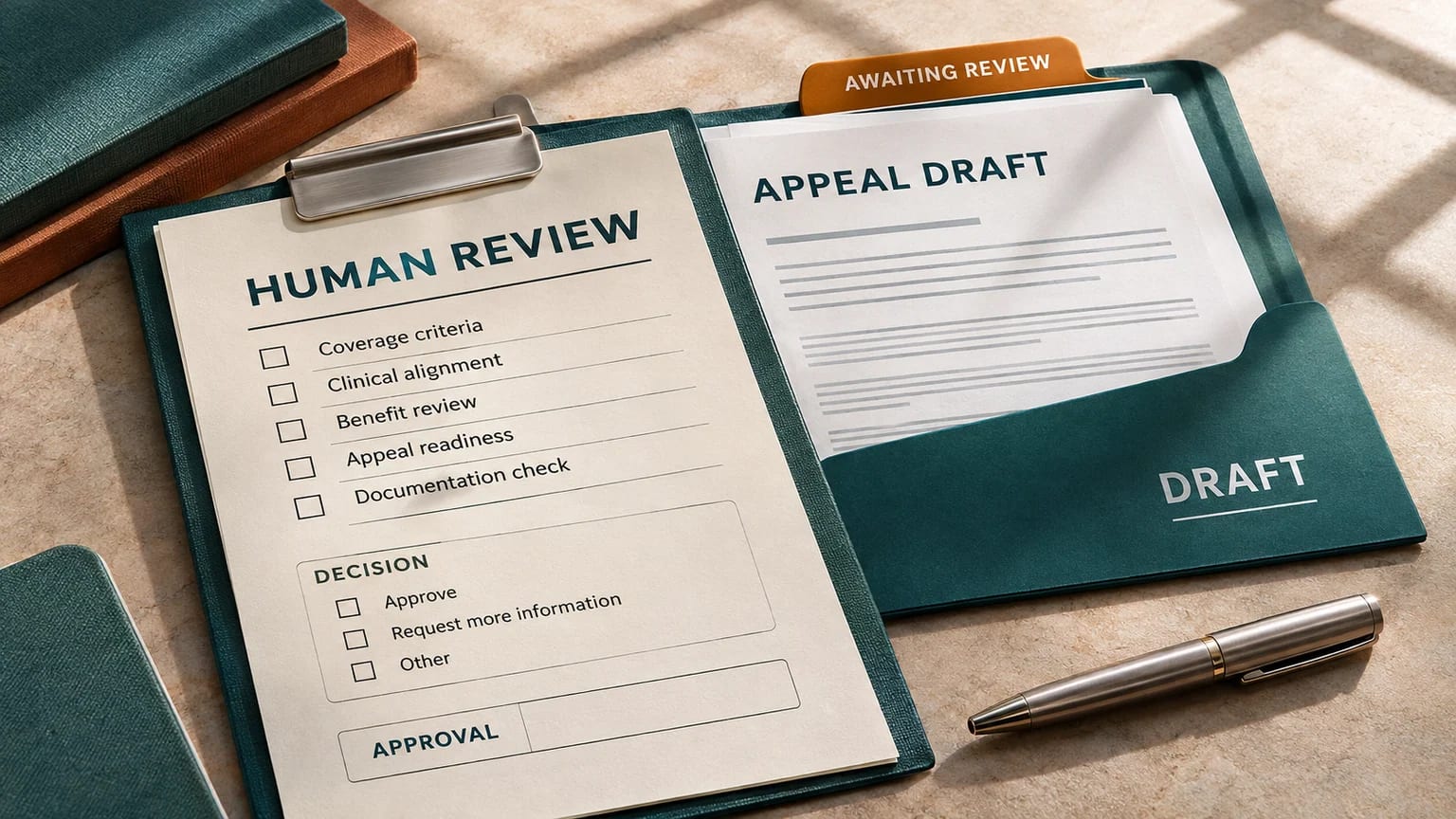
A named qualified author reviews, corrects, and authenticates clinical documentation under the approved process. Administrative review cannot replace that responsibility. Measure the time required to verify the output as well as typing time saved; a faster draft may still create more work.
Treat predictive analytics as a separate evidence question
Ask what the model predicts, for whom, using which data, with what validation, uncertainty, limitations, and action pathway. A prediction is not a diagnosis or proof that an intervention will prevent an outcome. Review subgroup performance and whether the information supports an appropriate decision.
For DSI or certified health IT questions, determine the actual regulatory and certification context. Do not apply one certification rule to every AI tool or use a transparency label as proof of effectiveness.
Respond professionally when a client uses AI
Whether someone mentions ChatGPT Health, an AI companion, or another tool, qualified clinicians can ask about the person's experience, purpose, perceived benefits, concerns, and relevant safety issues. Avoid assuming all use is harmful or that a branded health chatbot provides a reliable clinical record. The clinical response depends on the actual situation.
Reports about AI companions, severe adverse experiences, or 'AI-induced psychosis' require careful attribution and assessment. Do not turn a headline into a diagnosis or a blanket causal claim. Establish the practice's appropriate clinical escalation and communication process.
Keep research data governance distinct from routine care tools
NIH's Autism Data Science Initiative describes research data integration with privacy protections. Review actual primary information and governance rather than treating an informal 'autism registry' label as a complete description. Research purpose, access, consent or other authority, privacy, participation, and potential stigma deserve distinct examination.
A practice should understand the actual information-sharing basis and the questions its patients or community raise. Do not claim that a research initiative either exposes every person's records or creates no privacy concern without examining the specific arrangement.
Release a narrow use with monitoring and an accountable stop route
Document the approved scope, prohibited uses, source boundaries, reviewers, test results, training, incident reporting, and rollback or suspension procedure. Reassess material vendor changes and new use cases rather than treating an initial approval as permanent.
Clinical efficiency case studies, conference impressions, and surveys can identify questions, but they do not establish the result for your practice. Keep the evidence, denominator, comparison, workload, and limitations visible before repeating a productivity or safety claim.
Common questions
Answers before you build.
Does a signed AI consent form establish compliance?
No. Appropriate consent is one part of the actual clinical, legal, contractual, privacy, security, and operational arrangement. Qualified owners review the complete use case.
Can an AI-generated note be signed without review?
The qualified author remains responsible for verifying accuracy, support, omissions, and the applicable authentication process. Fluent text is not proof that the underlying facts are correct.
Does a prediction establish that a clinical outcome can be prevented?
No. Prediction, causal understanding, intervention effectiveness, and an appropriate response pathway are distinct evidence questions.
Practical closeout
Use this operator checklist.
- Classify the actual function and data flow before evaluating a brand.
- Consent, contracting, security, clinical appropriateness, and accuracy are separate checks.
- Measure review and correction work as part of any efficiency claim.
- Do not let a prediction or fluent conversation substitute for accountable clinical judgment.
Continue through the cluster
Verified customer case studies are added only with customer permission and supporting evidence; none is implied by these operational examples.
Sources & methodology
Trace the operational claims.
Marsa Health Editorial reviewed the primary and research sources below on November 5, 2026. We translate them into workflow controls, distinguish proposals from final rules, and flag where plan, program, state, contract, or clinical requirements vary.
- 01Minimum necessary requirement HHSPrivacy guidance with defined scope and exceptions; organizations establish approved information handling.Accessed or rechecked November 5, 2026
- 02Security Rule guidance material HHSSecurity implementation background; marketing descriptions do not establish a vendor's compliance.Accessed or rechecked November 5, 2026
- 03Decision support interventions ONCSpecific certification and transparency context; verify applicability.Accessed or rechecked November 5, 2026
- 04Autism Data Science Initiative NIH DPCPSIPrimary research-initiative information, distinct from assumptions based on informal labels.Accessed or rechecked November 5, 2026
- 05Psychotherapies NIMHGeneral psychotherapy background, not a substitute for professional assessment or a treatment protocol.Accessed or rechecked November 5, 2026
Organizational author. Editorial review covers source accuracy, search intent, workflow boundaries, and human-oversight requirements. This material is educational and does not provide clinical, legal, coding, or coverage advice.
No named clinical or legal expert reviewer is attributed to this version. Marsa Health does not invent reviewer credentials.
Read our editorial methodRevision history
What changed and when
November 5, 2026
Initial publication, source review, and operational editing.