
Authorization units versus visits: stop tracking an undefined balance
A practical method for defining authorized quantity, reconciling scheduled and delivered services, and preventing a visit count from becoming an unsupported billing-unit balance.
Direct answer
Authorization units versus visits: what operators need to know
A practical method for defining authorized quantity, reconciling scheduled and delivered services, and preventing a visit count from becoming an unsupported billing-unit balance. A number needs a quantity basis and source. Keep the authorization's date range separate from quantity. Scheduled, delivered, billed, and adjudicated are different states.
20 minutes · Your payers and levels of care · No patient information needed
See the workflow: Prior-authorization workflow.
On this page: Direct answer

An authorization balance is useful only when its quantity basis is defined. Visits, billing units, days, and service periods are not interchangeable. Record the quantity exactly as the applicable decision defines it, retain the source, and distinguish scheduled, delivered, billed, and adjudicated quantities. Never assume that one appointment consumes one billing unit or that a remaining date range proves quantity remains available.
This article explains how an operations team can build a reproducible balance without turning a spreadsheet into a coding authority. The examples use invented values solely to demonstrate arithmetic and handoffs. Confirm service definitions, reporting requirements, authorization conditions, and any conversion method with the applicable payer guidance and your qualified billing or coding reviewer. No public example can establish permission to deliver or bill a particular service.
Key takeaways
The short version
- A number needs a quantity basis and source.
- Keep the authorization's date range separate from quantity.
- Scheduled, delivered, billed, and adjudicated are different states.
- Use a named reconciliation owner and a checked date.
- Preserve amendments and corrections instead of silently overwriting history.
Take the template with you
Free to copy · no email required
Authorization quantity field dictionary
Blank operational definitions. No patient rows or clinical records belong in the public worksheet.
Field,Definition,Source,Owner,Refresh trigger
Quantity basis,Visits units days or another confirmed basis,Applicable written decision,,New or amended decision
Authorized quantity,Quantity under the confirmed basis,Applicable written decision,,New or amended decision
Delivered quantity,Confirmed delivered services under the same basis,Approved source record,,Reconciliation
Scheduled quantity,Planned services not assumed delivered,Scheduling source,,Schedule change
Balance checked date,Time sources were last reconciled,Reconciliation record,,Completed review
Saves as authorization-quantity-dictionary.csv
Try the workflow · fictional demo case
What does a balance of six actually mean?
A fictional tracker shows approved quantity 12, delivered quantity six, and next week's schedule of four appointments. The basis is missing.
Select a check to reveal the finding and next action. Nothing is sent to a payer.
0 of 3 checks reviewed. A named person still approves the next action.
This fictional example illustrates an offered Marsa workflow. We do not connect this public example to a payer or present it as a customer result. We measure demo starts and completions using fixed labels; no input text is collected.
Explore authorization, appeals, benefits, claims, audit, and coordination automations1. Give every quantity a definition
Start by locating the written authorization decision and identifying what its quantity represents. A tracker that records only approved 12 has discarded information needed by the next person. Add a quantity-basis field beside the number, and keep an evidence reference to the decision in an approved system. If the decision is ambiguous, the row should say clarification required. A blank or uncertain definition is safer than a confident interpretation that nobody can source.
The field dictionary should explain the basis in language staff can use consistently. It should identify the applicable service or level of care, any relevant period, and the source of the definition. Do not create a generic units-per-visit rule across different services merely because it makes the spreadsheet easier to calculate. A useful dictionary records the scope of a definition and who approved it, including when that approval should be reviewed.
Treat the dictionary as operating documentation rather than a coding manual. Coding, billing, and authorization rules may interact, but they are not the same rule. If a clinical service changes, or a payer describes the authorized quantity differently from the claim's reporting basis, the team needs an explicit reconciliation method reviewed by the appropriate person. Spreadsheet formulas should implement that agreed method; they should not quietly decide what the method is.
2. Separate the states staff commonly collapse
Scheduled quantity is planned work. Delivered quantity reflects the services actually provided under the organization's source record. Documented quantity reflects what has completed the relevant documentation process. Billed quantity reflects what was reported for payment, and adjudicated quantity reflects what the payer has processed. Depending on your workflow, some of these distinctions may be unnecessary in the main tracker. The important point is that one field must not change meaning depending on who reads it.
A canceled appointment illustrates the issue. Scheduling may remove it immediately, while a copied forecast still includes it and billing never receives a corresponding service record. None of those numbers is inherently wrong; they answer different questions at different times. Label the forecast as a forecast, keep delivered work anchored to its source, and avoid using a planned count as proof of consumption. A reconciliation should explain differences instead of forcing all totals to match.
Do not add five manually maintained counters if the team only needs two. Decide which decision each field supports and where its authoritative source lives. A tracker can display a delivered balance and a separate planned-demand estimate without duplicating the entire billing system. The acceptance test is whether the next reviewer can identify which figure is confirmed, which is planned, and what event causes either one to change.
3. Track the date range independently
An available quantity does not establish that a future service falls inside the authorization's date range. Likewise, a date range that has not ended does not establish that quantity remains. Store both dimensions and make the difference visible in the handoff. A renewal review should ask about the next binding constraint rather than assume that the end date is always the first condition that needs attention.
In a fictional example, a decision has a defined quantity of 12 visits within an invented service period. Eight visits have been delivered and five more are planned inside that period. The confirmed remaining quantity is four visits under the example's stated assumptions, while planned demand is five. That is a one-visit planning gap for review. It does not tell the team what remedy the payer permits, whether more services are medically necessary, or whether an additional request will be approved.
Use the gap to trigger a next action, not an automatic scheduling or coverage decision. The owner checks the source records, the actual planned services, and the applicable request process. If the decision's period or quantity is amended, the reviewer records the change before recalculating. This keeps a forecast useful without allowing an arithmetic result to become an unsupported statement that the patient is cleared or payment is assured.
4. Make the balance reproducible
For a simple authorization with one confirmed quantity basis, a working balance may be calculated as authorized quantity minus confirmed consumed quantity under that same basis. The important phrase is under that same basis. Do not subtract appointments from units, days from visits, or claims from service counts. Where the arrangement needs a more complex method, document it separately and have the qualified reviewer approve the method before relying on the result.
Record the inputs, source references, calculation version, reconciliation date, and reviewer. The public template contains field names only; your organization retains the actual evidence in its approved systems. A second reviewer should be able to reproduce the result without asking the original owner which hidden tab or remembered adjustment was used. If the calculation depends on a manual adjustment, name the reason and evidence instead of burying it in the final number.
Set a rule for unresolved differences. A balance that cannot be reconciled should carry an exception status and next action, with the last confirmed value clearly dated. Do not replace it with zero just to be conservative or with the expected value just to keep operations moving. Either substitution can mislead a later reader. The useful state is known quantity with a stated limitation, or unresolved quantity awaiting a specific verification step.
5. Handle amendments without erasing the earlier decision
A later decision can change the operational picture, but staff need to know whether it replaces, extends, supplements, or otherwise modifies the earlier record under the applicable payer process. Preserve the decision history and the effective scope of the change. An added number in a spreadsheet is not enough evidence that the quantities should be combined. If the relationship between decisions is unclear, record a payer question and assign an owner to resolve it.
The same discipline applies when an internal source record is corrected. Identify what changed, who approved the correction, and which downstream balances need to be recalculated. Keep an audit trail of the previous value and the reason. A team can explain a corrected balance when the sequence is visible. It becomes much harder to investigate an unpaid claim when an earlier total has disappeared and no one can reconstruct what billing saw at the time.
Notify the people who rely on the balance. An authorization amendment may affect scheduling, utilization review, billing, or more than one location. The handoff should identify the changed record, the revised interpretation, the evidence location, and any action the recipient must take. Require acknowledgment where the change matters. A notification sent to a shared inbox is not the same as an accepted handoff with somebody responsible for the next step.
6. Use an exception queue instead of a notes graveyard
Common exceptions include unclear quantity basis, missing decision evidence, conflicting source totals, an amendment awaiting interpretation, a location change, and a delayed reconciliation. Give each exception a category, owner, next action, target review time, and evidence reference. These are process controls. They do not establish the payer's deadline, and an internal target should be labeled as such unless a verified external requirement supports the date.
Keep the next action specific. Ask whether the later decision replaces or supplements the earlier quantity is actionable. Check authorization is too broad to assign or verify. If another department must respond, include the exact question and the minimum evidence it needs. Avoid sending an entire workbook and expecting the recipient to infer the problem. A small, well-defined exception is easier to resolve than an unexplained red row.
Review stale exceptions by the decision they block. A reconciliation needed for next week's renewal may have a different urgency from a historical reporting discrepancy. Clinical continuity, billing requirements, and operational deadlines require their own authorized review; a generic financial score should not make those decisions automatically. The queue should help a named person see and approve the next action, including when escalation is needed.
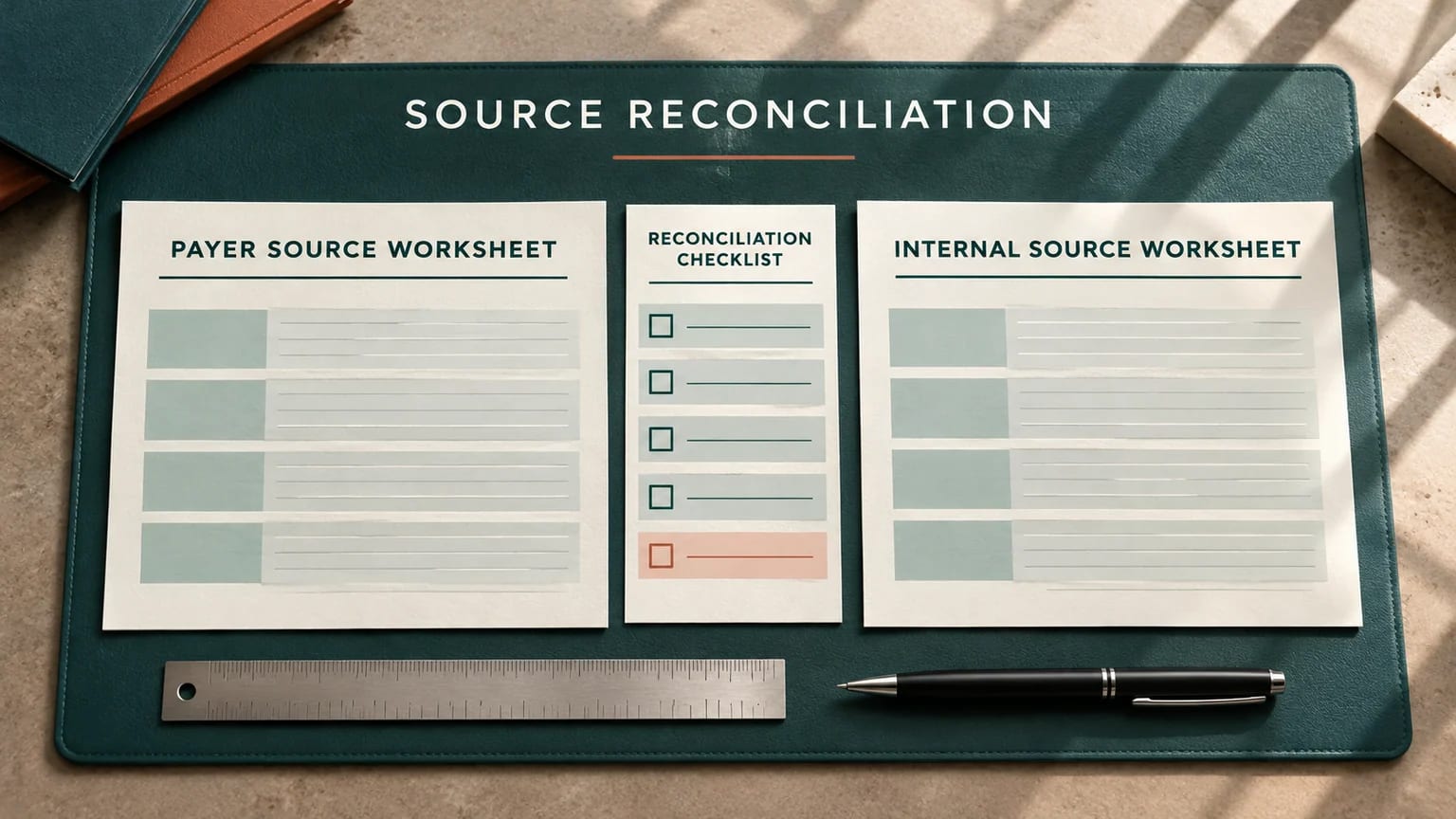
7. Write the handoff a backup can actually use
A useful quantity handoff contains the applicable arrangement, source decision, confirmed basis, approved quantity, consumed quantity under that basis, remaining quantity, date range, checked date, known limitations, owner, and next action. You may store those details across approved systems rather than in one sheet. What matters is that the recipient can reach them and understand their relationship without reconstructing the case from messages.
Test the handoff with synthetic examples before relying on it. Give a backup reviewer a case with a cancellation, a late documentation update, and an amended decision. Ask what is confirmed, what is planned, what remains unknown, and which next action requires approval. The test should reveal ambiguous definitions rather than reward the reviewer for guessing what the designer intended. Revise the dictionary when two competent people reasonably interpret a field differently.
For recurring absences or multi-location operations, define who accepts ownership. Naming a backup in a policy is useful, but it does not prove that the backup received a particular exception. An accepted handoff includes the next review point and the evidence needed. When the original owner returns, reconcile any changes instead of creating two parallel versions of the balance. One reliable source and a visible timeline are easier to maintain than competing personal trackers.
8. Measure balance quality without overstating the outcome
Begin with a few direct measures: the share of relevant authorizations with a sourced quantity basis, the share reconciled within your defined working interval, the number of unresolved source differences, and the number of amendments awaiting a dependent handoff. Report denominators and definitions. Ten unresolved balances out of twelve needs a different response from ten out of a thousand, and a newly stricter definition can initially make the count rise.
Inspect whether the measures are driving the behavior you want. If staff enter an assumed basis to avoid an incomplete-field flag, the report looks better while the record becomes less trustworthy. Allow an explicit unknown state with an assigned next action. A useful quality process distinguishes a known gap from an unrecorded assumption. Sample review is necessary because a filled field does not prove that its source is correct.
Payment and denial trends may provide longer-term context, but they do not isolate the effect of a quantity-control change. Volume, payer mix, service mix, staffing, and posting timing can all influence the result. Keep the implementation date and any definition changes beside the report. Do not claim that adding a column recovered a certain amount unless the underlying case evidence and attribution support that statement.
What to do when the working balance is negative
A negative result is an exception to investigate, not permission to change the underlying records. Check for duplicate consumption, a missing amendment, inconsistent quantity bases, and timing differences between sources. Preserve the calculation that produced the result and assign the verification action. The appropriate response to any actual uncovered period or disputed quantity belongs with the organization's authorized clinical, operational, billing, and compliance reviewers.
9. Use the free dictionary, then inspect the workflow
The downloadable field dictionary is a starting structure, not a payer rulebook. Adapt it with your authorized operational, billing, and coding reviewers. The interactive example uses fixed fictional values so you can see how a missing basis becomes a next action before anybody asks for contact details. It does not store patient information, perform a live calculation on your cases, or communicate with a payer.
Marsa Health's governed payer-operations approach connects a case owner, readiness checks, evidence, next action, and timeline. A named human approves the work before anything goes to a payer. If your tracker has a balance field that people interpret differently, the free payer-fit check can review the headers and process descriptions. Keep the working file private. Questions can go to team@marsahealth.com without attaching patient records.
Common questions
Answers before you build.
Is one visit always one authorization unit?
No universal conversion should be assumed. Use the quantity basis in the applicable decision and obtain qualified review of any service-specific reporting or conversion method.
Should scheduled appointments reduce the confirmed balance?
Keep planned demand distinct from confirmed consumption. Your organization should define each source and the approved reconciliation method.
What should an unknown balance show?
Show the uncertainty, the last confirmed value and date if available, an exception owner, and a specific next verification action. Do not silently substitute an assumed number.
Practical closeout
Use this operator checklist.
- A number needs a quantity basis and source.
- Keep the authorization's date range separate from quantity.
- Scheduled, delivered, billed, and adjudicated are different states.
- Use a named reconciliation owner and a checked date.
- Preserve amendments and corrections instead of silently overwriting history.
Continue through the cluster
Verified customer case studies are added only with customer permission and supporting evidence; none is implied by these operational examples.
Sources & methodology
Trace the operational claims.
Marsa Health Editorial reviewed the primary and research sources below on November 4, 2026. We translate them into workflow controls, distinguish proposals from final rules, and flag where plan, program, state, contract, or clinical requirements vary.
- 01CMS Interoperability and Prior Authorization Final Rule CMSBackground on specified payer authorization requirements; it does not define a universal conversion between visits and units.Accessed or rechecked November 4, 2026
- 02Health care payment and remittance advice CMSBackground on payment responses. The quantity dictionary, calculations, examples, and controls are original editorial recommendations, not coding instructions.Accessed or rechecked November 4, 2026
- 03Electronic Prior Authorization Centers for Medicare & Medicaid ServicesCurrent CMS provider-readiness guidance for 2027 electronic prior authorization, EHR questions, FHIR testing, and workflow preparation.Accessed or rechecked November 4, 2026
- 04Minimum Necessary Requirement U.S. Department of Health and Human ServicesHIPAA guidance on limiting uses, disclosures, and requests for protected health information when the standard applies.Accessed or rechecked November 4, 2026
Organizational author. Editorial review covers source accuracy, search intent, workflow boundaries, and human-oversight requirements. This material is educational and does not provide clinical, legal, coding, or coverage advice.
No named clinical or legal expert reviewer is attributed to this version. Marsa Health does not invent reviewer credentials.
Read our editorial methodRevision history
What changed and when
November 4, 2026
Initial publication, source review, and operational editing.