
The Weekly Payer-Operations Meeting: A Decision Log Your Team Can Use
A free behavioral-health payer-operations meeting agenda, decision log, fictional queue review, measurement definitions, and practical follow-up checks.
Direct answer
Payer operations weekly meeting template: what operators need to know
A free behavioral-health payer-operations meeting agenda, decision log, fictional queue review, measurement definitions, and practical follow-up checks. Review exceptions that require a decision rather than reading every row aloud. Keep payer deadlines, internal targets, and next checks distinct. Use stable definitions and denominators before comparing weekly numbers.
20 minutes · Your payers and levels of care · No patient information needed
See the workflow: Prior-authorization workflow.
On this page: Direct answer
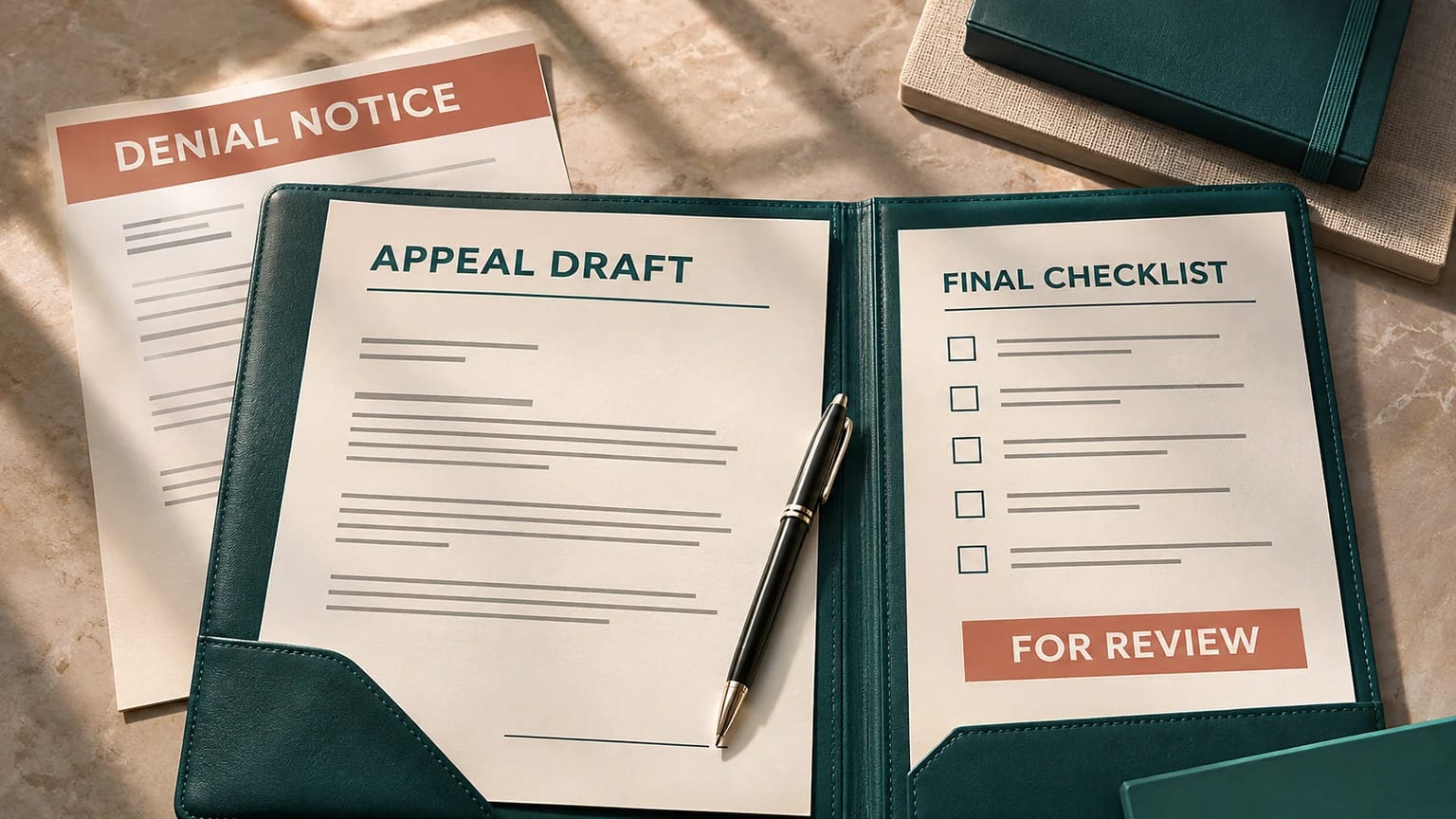
A weekly payer-operations meeting should produce decisions that a named person accepts and the team can verify later. Use it for blocked work, changed decisions, unclear ownership, and recurring process gaps. Routine updates belong in the operating record before the meeting. Reading the entire queue aloud can consume the time needed to resolve the exceptions that actually require discussion.
This free guide includes a thirty-minute example agenda, a downloadable decision log, and a fictional behavioral-health queue review. Adapt the structure to your organization's staffing, approved systems, and applicable requirements. It does not establish payer deadlines, clinical decisions, or permission to share records. The public worksheet needs process-level references; actual case evidence stays in the approved internal arrangement.
Key takeaways
The short version
- Review exceptions that require a decision rather than reading every row aloud.
- Keep payer deadlines, internal targets, and next checks distinct.
- Use stable definitions and denominators before comparing weekly numbers.
- End with accepted ownership, evidence references, and a scheduled verification of each material decision.
Take the template with you
Free to copy · no email required
Weekly payer-operations decision log
A reusable agenda structure with decision, owner, acceptance, and verification fields. Keep real records in approved systems.
Agenda segment,Question requiring decision,Secure evidence reference,Decision,Named owner,Receiver acceptance,Internal check,Verification result
Approaching requirement or deadline,,,,,,,
Unowned or blocked work,,,,,,,
Changed decision handoff,,,,,,,
Recurring source or process gap,,,,,,,
Prior decision follow-up,,,,,,,
Saves as weekly-payer-operations-decision-log.csv
Try the workflow · fictional demo case
Turn a queue summary into an owned decision
A fictional weekly review shows three cases waiting on evidence, one amendment awaiting billing acknowledgment, and a completed packet with no next-check owner.
Select a check to reveal the finding and next action. Nothing is sent to a payer.
0 of 3 checks reviewed. A named person still approves the next action.
This fictional example illustrates an offered Marsa workflow. We do not connect this public example to a payer or present it as a customer result. We measure demo starts and completions using fixed labels; no input text is collected.
Explore authorization, appeals, benefits, claims, audit, and coordination automations1. Set the meeting's decision boundary
Write a short purpose statement: this meeting resolves ownership, evidence, and handoff exceptions in payer work and verifies prior operating decisions. Identify who can decide each type of question. A coordinator may assign preparation work while a qualified reviewer handles a clinical or other judgment. Contracting, financial, privacy, security, or legal questions may require different owners. The meeting should not grant authority that a participant does not otherwise hold.
Choose a facilitator, operating-record owner, and backup. The facilitator keeps discussion on the decision required. The record owner captures the accepted action in the authoritative system rather than leaving it only in meeting notes. A backup helps maintain continuity during absence. One person can hold more than one role, but the team should know who is responsible for each part of the process.
Agree which work bypasses the weekly cadence. A time-sensitive event cannot wait simply because the next meeting is on Friday. The organization's approved escalation process should handle urgent or consequential questions as they arise. The weekly review can inspect whether that process worked and whether the instruction needs improvement. Keep actual payer requirements separate from the internal meeting schedule and review targets.
2. Prepare a small exception packet before the meeting
Ask owners to update the authoritative queue before the meeting. Each proposed discussion item should state the secure case reference, decision needed, relevant source, current owner, unresolved question, and proposed next action. Avoid copying entire records into an agenda. The participants need enough context to decide responsibly and a permitted route to the underlying evidence when their role requires it.
Select items using explicit reasons: no accepted owner, conflicting source, missing material evidence, amended decision awaiting acknowledgment, approaching verified requirement, repeated return, or prior decision not implemented. Your actual categories should reflect observed work. A category is useful when it changes what the group does. A long list of vague red statuses can obscure which question the meeting must resolve.
Have the facilitator return incomplete discussion items for clarification where the timing permits. Please discuss this case is not a useful decision request. A stronger version is: the source does not establish whether the amended quantity replaces or adds to the earlier total; assign the approved clarification route and receiving reviewer. That wording narrows the discussion and preserves uncertainty instead of inviting the group to guess.
3. Use a thirty-minute example agenda
Spend the first five minutes reviewing changes that affect current work: an applicable instruction, staffing coverage, source availability, or a material operating exception. Use the next ten minutes for the highest-consequence blocked or unowned items. Reserve another five for changed-decision handoffs, five for recurring process gaps, and five for decision read-back and prior-action verification. These timeboxes are an editorial starting point, not a universal operating standard.
The facilitator should stop a discussion when it needs evidence or authority that is not present. Capture the exact question, named verification owner, source to consult, and internal return point. The group does not need to fill every blank before the meeting ends. A precise unresolved question with accepted ownership is more useful than a confident conclusion unsupported by the material available.
Keep routine status announcements out of the discussion unless they expose a decision. If an owner says a packet is pending, ask what condition makes it pending and what the meeting needs to resolve. The answer may be a missing item, an unaccepted review, or a future check already assigned. Only the first two may require group attention. The meeting should help the queue become more actionable rather than duplicate its contents verbally.
4. Review deadlines, internal targets, and next checks separately
For any approaching requirement, identify the applicable source, scope, and qualified verification owner. Do not infer a universal payer deadline from a generic guide or another arrangement. The record should distinguish the payer's stated requirement from the organization's internal review target and next status check. Each field answers a different operating question and may have a different owner.
An internal target can create time for evidence preparation and review. It should be labeled as the organization's choice rather than presented as an external requirement. A next check identifies when someone will look for a response or verify an action. It does not prove that the underlying deadline was met. These distinctions help a backup understand both the urgency and the evidence needed to continue.
When the source is ambiguous, assign a narrow clarification instead of allowing the meeting to choose a convenient interpretation. Record the question and the approved route. If qualified advice or another authority is required, name that dependency. The decision log should show what is unresolved and what the organization will do next under its established process, without turning the meeting itself into a substitute source of payer rules.
5. Work through a fictional blocked-evidence queue
Harbor Example has three cases waiting on supporting evidence. The summary count alone does not tell the meeting what to do. The first has a named evidence owner and an accepted internal target. The second was sent to a shared inbox without acceptance. The third contains two conflicting source descriptions that require a qualified reviewer to identify the next verification question.
The meeting leaves the first case with its current owner unless new evidence changes the plan. For the second, the appropriate receiver accepts the request and confirms the secure source location and internal check. For the third, the qualified owner accepts the narrow source-comparison question. The group does not invent the missing fact or mark all three cases complete merely because each was discussed.
Record the different decisions. One item required no change, one required accepted ownership, and one required qualified review. That distinction can reveal a process problem: perhaps the team repeatedly sends evidence requests without naming a receiver. The response might be a clearer handoff rule and a small retrieval test. The meeting should identify the condition causing repeated friction rather than repeatedly reminding everyone to communicate better.
6. Reconcile a changed decision with the receiving owner
The fictional queue also includes an amendment that changed part of an authorization after billing received the original summary. Ask the source owner to identify the changed field, source version, and affected period. Ask the receiving billing owner what dependent work needs review. A new green status does not establish that the earlier handoff has been reconciled.
The meeting decision should name who reviews the interpretation, who updates the authoritative internal record, and who accepts the downstream action. Preserve the original event and the later correction. If the amendment wording is unclear, the next action is verification through the approved route. Do not let the meeting resolve an additive-versus-replacement quantity question through an unsupported arithmetic assumption.
At the next internal check, inspect evidence that the receiving owner acted. An agenda note saying billing notified proves very little without the relevant acceptance and update. The verification can remain concise, using secure references in the approved system. The purpose is to establish continuity of work, not to create a second detailed record inside the meeting log.

7. Give completed internal work a next-event owner
A packet can be prepared and reviewed while the payer response remains outstanding. In the fictional queue, one completed packet has no named next-check owner. The meeting assigns that responsibility and identifies the evidence the owner should inspect. It does not convert internal completion into a favorable decision or assume that a later payment necessarily resulted from that packet.
Use stable milestone definitions. Prepared output, named review, approved payer action, acknowledgment, response, favorable decision, and payment reconciled are different events. Your organization may use a different set, but each should have a documented meaning. CMS remittance guidance provides background on financial evidence; it does not make an internal completion label equivalent to payment or establish a universal appeal process.
Ask whether the next owner can retrieve the approved output and action evidence. If the record depends on the original operator's personal folder or memory, assign a retrieval correction. A meeting can close an internal decision only when the receiver understands and accepts the next action. The underlying payer case may remain open, and reporting should preserve that distinction.
8. Compare weekly numbers with stable definitions
Choose a small set of measures tied to decisions: unowned exceptions, missing-evidence work, review waiting, changed decisions awaiting acknowledgment, and prior decisions awaiting verification. State the population and observation period. A larger queue may reflect more incoming work, a broader scope, or a definition change rather than worse operating performance. Ask what changed before drawing a conclusion.
Separate active preparation from waiting. A team might reduce drafting time while the same missing-evidence delay remains. Another week might show more reopened work because staff improved discovery rather than because quality deteriorated. Review the underlying sample and event history. Do not reward a closed-row count that encourages staff to hide uncertainty or close work before a receiving owner accepts it.
Keep financial measures distinct. Amount at risk is not collected revenue, a favorable decision is not necessarily a reconciled payment, and an observed improvement does not prove that a single tool caused it. Use local records and approved definitions for the actual report. The meeting can identify a promising process change without overstating the financial result or applying a vendor case study to a different population.
9. Close with decision read-back and acceptance
Read each material decision back in a compact format: question, decision or unresolved item, named owner, receiving role, secure source reference, internal check, and escalation if needed. Ask the receiver to confirm the next action and raise a question if something is unclear. AHRQ handoff guidance supports attention to receiver understanding; this payer-work format is an editorial adaptation for operational coordination.
Update the authoritative queue after the read-back. The meeting log should point to the operating record rather than compete with it. If a decision changes an owner or next action, the person working the case needs to see that update where they actually work. Assign responsibility for the update explicitly instead of assuming the note taker will translate every discussion into several systems.
Send only the process information permitted under the organization's approved arrangement. HHS minimum-necessary guidance has defined applicability and exceptions; qualified owners establish the actual internal practice. Public templates and contact forms do not need real records. A concise decision reference can preserve accountability without distributing detailed evidence to people who do not need it for their role.
10. Verify one process improvement instead of adding more meetings
At the next review, inspect whether prior actions occurred and whether they solved the stated problem. For the fictional shared-inbox issue, sample a few new handoffs and ask whether a named receiver accepted them. For the amendment issue, check whether the reviewed change reached the dependent owner. A process instruction is useful only if staff can follow it and the operating record supports the intended result.
Choose one small correction when a pattern repeats: a better source field, a narrower evidence question, a backup role, a clearer acknowledgment rule, or a retrieval test. Assign an owner and a check. Avoid responding to every gap with another recurring meeting or a more elaborate dashboard. The team needs a maintainable process that leaves the next action clearer than it was before the review.
Marsa offers queue coordination, reporting, evidence preparation, authorization, appeal, benefits, claims, and audit-response automation with named human review. Use this free agenda and decision log independently or inspect the fictional workflow demo. The ungated payer-fit sample shows a concrete output before you provide contact details. Implementation confirms the required connections and responsibilities; business questions can go to team@marsahealth.com while actual records remain in approved systems.
Keep one decision visible until verified
Carry a material decision forward as awaiting verification until the agreed evidence is available. Discussion, assignment, and implementation are separate events. This small distinction prevents a meeting from appearing productive solely because every agenda item received a verbal answer. The next review can then focus on the result rather than repeating the same conversation.
Common questions
Answers before you build.
How long should the meeting be?
Use a timebox the team can maintain and adapt it to the actual queue. This guide proposes a thirty-minute example, not a universal standard.
Should the meeting include patient details?
Use the minimum process information needed under the approved internal arrangement. Public templates and forms do not need patient information; actual records stay in approved systems.
What should happen after the meeting?
Named owners accept the decisions, update the authoritative operating record, and verify the agreed action at its internal check. New urgent work follows the approved escalation process.
Practical closeout
Use this operator checklist.
- Review exceptions that require a decision rather than reading every row aloud.
- Keep payer deadlines, internal targets, and next checks distinct.
- Use stable definitions and denominators before comparing weekly numbers.
- End with accepted ownership, evidence references, and a scheduled verification of each material decision.
Continue through the cluster
Verified customer case studies are added only with customer permission and supporting evidence; none is implied by these operational examples.
Sources & methodology
Trace the operational claims.
Marsa Health Editorial reviewed the primary and research sources below on November 4, 2026. We translate them into workflow controls, distinguish proposals from final rules, and flag where plan, program, state, contract, or clinical requirements vary.
- 01Handoff tool AHRQ TeamSTEPPSCommunication background for receiver understanding and acceptance. This payer-operations meeting is an original editorial adaptation, not a clinical protocol.Accessed or rechecked November 4, 2026
- 02Minimum necessary requirement HHSPrimary guidance with defined applicability and exceptions. The organization establishes its approved internal data-handling arrangement.Accessed or rechecked November 4, 2026
- 03Health care payment and remittance advice CMSPrimary background for separating financial evidence from internal workflow milestones. No universal appeal requirement is inferred.Accessed or rechecked November 4, 2026
- 04CMS Interoperability and Prior Authorization Final Rule CMS-0057-F Centers for Medicare & Medicaid ServicesCurrent implementation dates, decision timeframes, denial-reason requirements, metrics, and API provisions for impacted payers.Accessed or rechecked November 4, 2026
- 05Electronic Prior Authorization Centers for Medicare & Medicaid ServicesCurrent CMS provider-readiness guidance for 2027 electronic prior authorization, EHR questions, FHIR testing, and workflow preparation.Accessed or rechecked November 4, 2026
Organizational author. Editorial review covers source accuracy, search intent, workflow boundaries, and human-oversight requirements. This material is educational and does not provide clinical, legal, coding, or coverage advice.
No named clinical or legal expert reviewer is attributed to this version. Marsa Health does not invent reviewer credentials.
Read our editorial methodRevision history
What changed and when
November 4, 2026
Initial publication, source review, and operational editing.