
Authorization Unit Reconciliation: Free Ledger and Worked Example
Reconcile authorized quantity, amendments, delivered work, cancellations, and duplicate entries with a free ledger and a reproducible fictional calculation.
Direct answer
Authorization unit reconciliation template: what operators need to know
Reconcile authorized quantity, amendments, delivered work, cancellations, and duplicate entries with a free ledger and a reproducible fictional calculation. Confirm a single quantity basis before subtracting. Reconcile decision amendments before adding their quantities. Count confirmed consumption from the agreed source.
Your columns or steps, not your data · Checked against your payer mix · Back in 2 business days
See the workflow: Prior-authorization workflow.
On this page: Direct answer
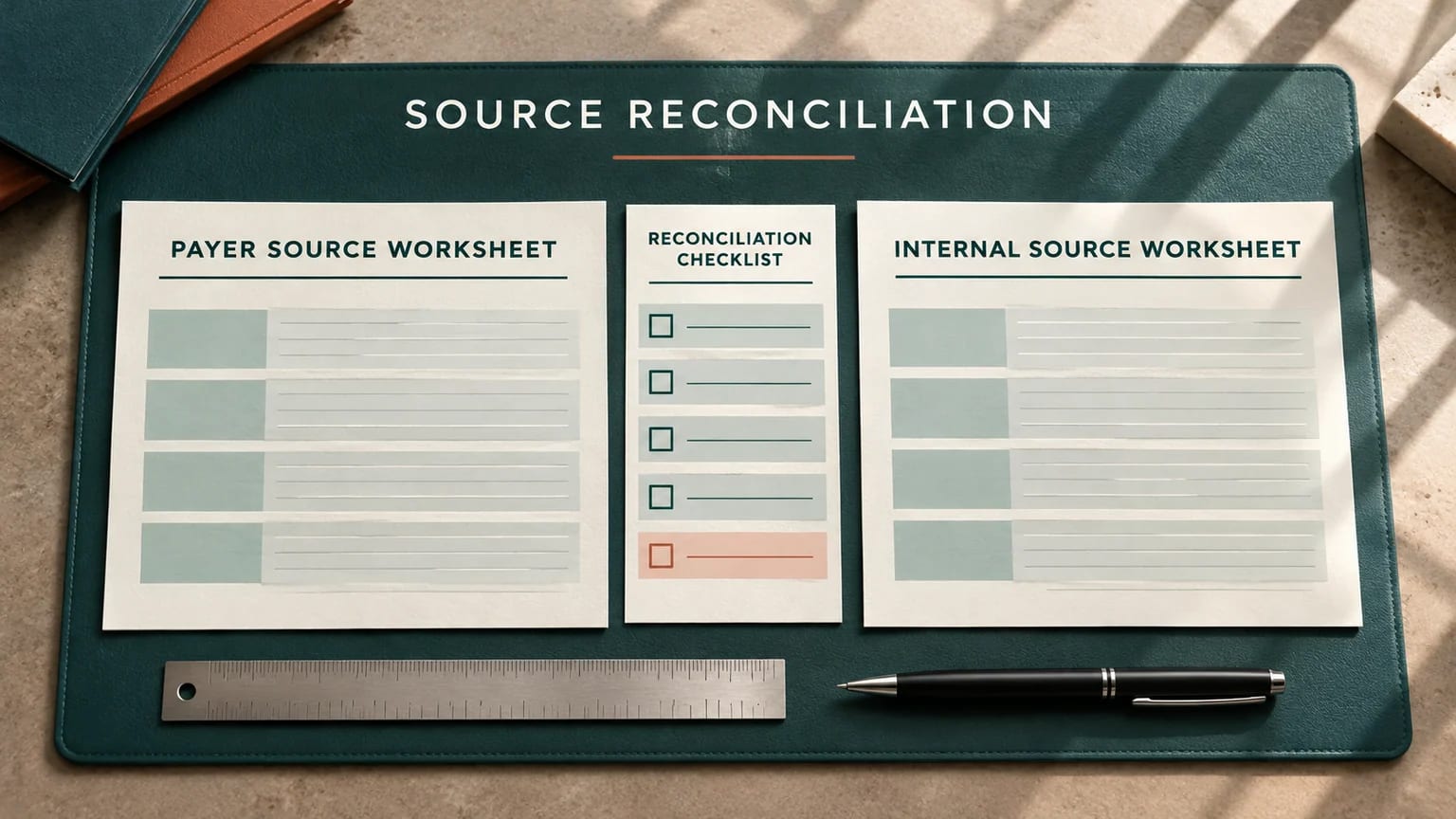
An authorization balance should be reproducible from the decision history and the organization's approved service records. Define the quantity basis, reconcile approved amendments, identify confirmed consumption, remove duplicates through an approved correction process, and retain the checked date and reviewer. Keep planned appointments separate. The result is a working quantity control, not a coverage determination or a substitute for coding and clinical review.
The free ledger below shows the structure with fictional values. It assumes a quantity basis has already been confirmed; the example does not define a conversion between visits, days, and billing units. Real decisions, service records, identifiers, and supporting documents stay in approved systems. If a source is unclear or quantities use different bases, stop the arithmetic and assign the clarification before treating a number as an operational balance.
Key takeaways
The short version
- Confirm a single quantity basis before subtracting.
- Reconcile decision amendments before adding their quantities.
- Count confirmed consumption from the agreed source.
- Keep cancellations, forecasts, and duplicates distinguishable.
- Record exceptions and the last verified balance instead of substituting a guess.
Take the template with you
Free to copy · no email required
Authorization quantity reconciliation ledger
Synthetic ledger and blank control fields. Replace the example only inside your approved organizational systems.
Event reference,Event type,Quantity basis,Authorized quantity change,Confirmed consumption,State,Secure evidence reference,Reviewer,Next action
DEMO-A,Initial decision,Confirmed example unit,24,0,Reviewed,Internal source reference,Demo reviewer,
DEMO-B,Delivered work,Confirmed example unit,0,10,Reconciled,Internal source reference,Demo reviewer,
DEMO-C,Potential amendment,Confirm relationship,0,0,Unresolved,Internal source reference,,Clarify whether replacement or additional
Saves as authorization-unit-reconciliation.csv
Try the workflow · fictional demo case
Would you add this amendment to the balance?
A fictional decision provides 24 defined example units and confirmed consumption is 10. A later document says 12, but its relationship to the original decision is unclear.
Select a check to reveal the finding and next action. Nothing is sent to a payer.
0 of 3 checks reviewed. A named person still approves the next action.
This fictional example illustrates an offered Marsa workflow. We do not connect this public example to a payer or present it as a customer result. We measure demo starts and completions using fixed labels; no input text is collected.
Explore authorization, appeals, benefits, claims, audit, and coordination automations1. Agree the quantity and source hierarchy
Write the quantity definition beside the ledger, including its service scope and the source that establishes it. A number called units can describe different things in different workflows. The authorization decision, service documentation, scheduling record, billing record, and remittance may each express activity differently. Your qualified reviewers should agree how those records relate before a spreadsheet formula is allowed to combine them.
Choose the authoritative source for each input rather than one source for every question. The retained decision establishes the reviewed authorization quantity and conditions. The organization's approved service record may establish delivered activity. Scheduling supplies planned demand. Billing supplies reported transactions. Each source has a purpose and update timing. A discrepancy between two totals can be a timing or definition difference rather than proof that either department entered the wrong number.
Record who approves the definition and who maintains it. If a service, payer arrangement, or source system changes, the reconciliation method may need review. Do not let an inherited formula become the unexamined policy. A useful ledger explains its assumptions well enough that a second authorized reviewer can reproduce the result and identify when the method no longer applies.
2. Reconcile decisions before consuming their quantities
List the initial decision and any amendment, extension, replacement, or clarification in event order. Preserve each source and its scope. A later document with a quantity does not automatically mean that quantity is additional. Determine its relationship to the earlier decision through the applicable source and qualified review. If the relationship is unclear, retain the uncertainty and assign a specific question rather than adding the numbers because both documents look approved.
Keep the decision's relevant period and service conditions visible alongside quantity. A remaining quantity and an unexpired period answer separate questions. An amendment may affect one without affecting the other. The ledger should identify the reviewed interpretation and the date it becomes applicable under the source. Avoid silently applying a later decision to earlier activity or assuming that the most recently downloaded document governs every service in the record.
When an interpretation changes, retain the previous working result and explain why the new result differs. The organization may need to understand what scheduling, utilization review, or billing saw at a particular time. A corrected balance is useful when its history is reconstructable. Overwriting the old number without a decision reference can turn a simple amendment into a difficult investigation later.
3. Define confirmed consumption and its cut-off
Identify which source establishes consumed quantity for this operating purpose and how frequently it is reconciled. Delivered, documented, billed, and adjudicated quantities may differ at a cut-off. State which one the working balance uses. A report labeled remaining without that definition invites different departments to draw different conclusions from the same number, especially when documentation or posting happens after the service event.
Use an observation cut-off so the reviewer knows what the reconciliation includes. A balance checked Monday morning may not include Monday afternoon's activity. That limitation should be visible beside the value. The team can still use a dated balance for an appropriate planning question, provided it does not present the value as a live clearance decision or a guarantee that a future service will be paid.
Keep forecast demand separate from confirmed consumption. In the fictional example, ten defined units are confirmed as consumed and six more are planned. The working balance and the planned-demand gap can both be useful, but they should not be collapsed. A canceled planned event should not require the team to unwind a false record of delivery. The ledger should make the state and source of each quantity clear.
4. Work the base calculation before adding complexity
Assume a fictional reviewed decision authorizes 24 example units under one confirmed basis and period. The agreed source establishes 10 units of consumption at the reconciliation cut-off. The working balance is 14. The arithmetic is straightforward because the example deliberately holds the quantity basis and scope constant. It does not establish the correct basis, reporting method, or permission for any real service.
Now add planned demand of six example units. The planning view shows 14 established units less six planned units, leaving eight units of potential margin under the example's assumptions. Label that result as a forecast comparison, not an updated confirmed balance. If planned demand changes, the forecast changes while confirmed consumption remains anchored to the service source. This separation makes the next renewal or review question easier to explain.
Finally introduce a later document showing 12 units with an unclear relationship to the initial decision. The correct next step is clarification. Adding12 would create a result that depends on an unverified interpretation. The ledger retains the established 14-unit balance with a visible limitation and an owner for the later decision question. A named reviewer decides the appropriate operating action while that question is unresolved.
| Fictional input or output | Value | Meaning |
|---|---|---|
| Reviewed authorized quantity | 24 | Defined example basis and scope only |
| Confirmed consumption at cut-off | 10 | Reconciled under the same basis |
| Established working balance | 14 | 24 minus 10; checked date and sources retained |
| Planned demand | 6 | Forecast, not evidence of delivery |
| Forecast margin | 8 | Planning comparison under stated assumptions |
| Later unclear decision | 12 | Not added until relationship and scope are reviewed |
5. Handle duplicates, cancellations, and corrections explicitly
A duplicate consumption entry can reduce the displayed balance without representing additional delivered work. Identify the source event and relationship before correcting it. Follow the organization's approved correction process and retain the reason, reviewer, and affected calculation. Do not delete an entry simply because removing it makes the balance look plausible. The evidence should explain why the item was duplicate and what the corrected ledger now represents.
A cancellation belongs to the planned-demand history unless the organization's source records establish a different relevant event. Keep cancellation and delivery distinct. If staff use a single combined counter, a schedule change can accidentally appear as restored authorized quantity. A separate forecast avoids that confusion and lets the team explain why the plan changed without implying that a payer decision or actual service record changed.
Corrections should trigger review of dependent work. If billing used an earlier quantity, the relevant owner may need the corrected source and next action. If a renewal forecast relied on a duplicate event, the coordinator should reconcile the planning view. Record acceptance of important handoffs. A fixed number in one sheet does not establish that every system or person relying on the earlier value has received the correction.
6. Give unresolved balances their own queue
Use explicit exception categories: quantity basis unclear, amendment relationship unresolved, source timing difference, potential duplicate, missing decision, or another defined issue. Each exception needs a named owner, next action, evidence reference, and review point. The category helps the manager understand the work; the next action tells the owner how to resolve the specific uncertainty. A general notes field rarely provides both reliably.
A negative balance should trigger investigation, not a silent substitution. Check the source sequence, basis, amendment interpretation, duplicate activity, and cut-off. Retain the calculation that produced the result. The organization's authorized clinical, billing, operational, and compliance reviewers determine the appropriate response to any actual disputed or uncovered period. A public arithmetic example cannot authorize a service or decide the applicable remedy.
Keep the last established value distinct from the current unresolved interpretation. A dated, limited value can be useful when its scope is clear. A guessed current value can be misleading even when intended to help. The acceptance question is whether the next reviewer can explain what is known, what remains uncertain, and which decision the team is waiting to make.

7. Build a small reconciliation routine
Choose a working cadence based on your actual workflow, source timing, and risk. The template does not prescribe a universal daily interval. At the agreed review point, collect the relevant decision changes and source activity, compare definitions and cut-offs, resolve or assign differences, and retain the checked result. A repeatable small routine is more useful than an elaborate month-end cleanup that leaves current work dependent on stale totals.
Use a second-person check for the cases or exceptions your organization identifies as needing it. The reviewer should reproduce the calculation from the retained sources and explain any adjustment. If the result depends on an undocumented manual change, the control is incomplete. The check should test the evidence, not merely confirm that a formula returns the same number twice.
Record the method version and material changes to definitions. A new source system or consumption rule can change a report without any change in actual work. Keep that context with the trend. Staff should know which rules apply to the current ledger and how earlier balances were produced. This makes the reconciliation usable for both immediate operations and later review.
8. Test the balance during an absence
Give a backup a synthetic ledger containing the 24-unit decision, ten units of consumption, six planned units, and the unclear 12-unit document. Ask for the established balance, forecast comparison, unresolved question, and next action. A useful answer preserves the distinction among all four. An answer that reports a combined total without checking the later document reveals a definition or handoff problem worth fixing.
Confirm that the backup can reach the secure source references under their own access and find the reviewer for a disputed interpretation. Sharing the workbook is not enough if the retained decisions live in the absent owner's personal folder. Address access through approved administration rather than sharing credentials or copying real records into an unapproved tool. The workflow should survive the absence within its normal controls.
When ownership returns, reconcile any changes made during coverage and record the accepted next action. Avoid creating two separate balance histories. The source ledger and timeline should show what changed, who reviewed it, and which dependent teams were notified. A handoff is successful when the next person can act from the record without reconstructing the original owner's memory.
9. Measure reconciliation quality directly
Track the share of relevant balances with a defined basis, retained decision history, checked cut-off, reproducible calculation, and owned exception where needed. Report denominators and inspect a sample. A field being filled does not establish that its source is correct. Allow explicit unknown states with next actions so the reporting process rewards evidence rather than encouraging staff to enter an assumed definition.
Separate a control improvement from a financial outcome claim. A more reproducible balance can reduce reconstruction work and expose missing handoffs. Payment and denial trends also depend on mix, volume, documentation, contract terms, and payer behavior. Keep those factors and the implementation date with any evaluation. Do not turn one resolved quantity question into a promised recovery rate or a claim that every remaining unit is payable.
Marsa offers authorization and concurrent-review automation, unit reconciliation, evidence controls, and connected payer-work handoffs. The fictional demo and free ledger show the review boundary without taking real inputs. You can use the worksheet independently or request a walkthrough of the offered workflow. Your implementation confirms the relevant source systems, payer arrangements, and responsibilities, while a named human approves payer actions.
10. Reconcile a late-posted event against the cut-off
In a synthetic exercise, record a usage event after the weekly report has been prepared but give it a service date inside the earlier period. Ask the operator to show whether the report reflects posting time, service time, or another defined cut-off. The answer should follow the documented internal definition rather than silently changing history. Preserve the earlier report and the reconciled update where the process requires it. This test helps a backup explain why two balances differ without assuming that one calculation is necessarily wrong or that a late-posted event creates additional authorized quantity.
Common questions
Answers before you build.
Can I add every approved amendment to the original quantity?
First establish whether it replaces, supplements, or otherwise changes the earlier decision, using the applicable source and qualified review.
Should planned appointments reduce confirmed consumption?
Keep planned demand separate. The organization should define the authoritative source and method for confirmed consumption.
Does a remaining balance guarantee payment?
No. It is an operating quantity control under defined assumptions, not a coverage, coding, or payment determination.
Practical closeout
Use this operator checklist.
- Confirm a single quantity basis before subtracting.
- Reconcile decision amendments before adding their quantities.
- Count confirmed consumption from the agreed source.
- Keep cancellations, forecasts, and duplicates distinguishable.
- Record exceptions and the last verified balance instead of substituting a guess.
Continue through the cluster
Verified customer case studies are added only with customer permission and supporting evidence; none is implied by these operational examples.
Sources & methodology
Trace the operational claims.
Marsa Health Editorial reviewed the primary and research sources below on November 4, 2026. We translate them into workflow controls, distinguish proposals from final rules, and flag where plan, program, state, contract, or clinical requirements vary.
- 01CMS Interoperability and Prior Authorization Final Rule CMSScoped prior-authorization context. The ledger and arithmetic are original fictional examples, not coding rules or universal payer instructions.Accessed or rechecked November 4, 2026
- 02Electronic Prior Authorization Centers for Medicare & Medicaid ServicesCurrent CMS provider-readiness guidance for 2027 electronic prior authorization, EHR questions, FHIR testing, and workflow preparation.Accessed or rechecked November 4, 2026
- 03Minimum Necessary Requirement U.S. Department of Health and Human ServicesHIPAA guidance on limiting uses, disclosures, and requests for protected health information when the standard applies.Accessed or rechecked November 4, 2026
Organizational author. Editorial review covers source accuracy, search intent, workflow boundaries, and human-oversight requirements. This material is educational and does not provide clinical, legal, coding, or coverage advice.
No named clinical or legal expert reviewer is attributed to this version. Marsa Health does not invent reviewer credentials.
Read our editorial methodRevision history
What changed and when
November 4, 2026
Initial publication, source review, and operational editing.